Fortes Clinic | Last updated September 2026
Smoking affects circulation, inflammation and the body’s ability to repair damaged tissue. These processes are also important to the normal function of the scalp and hair follicles, which is why smoking matters when investigating thinning hair or planning a hair restoration procedure. But does smoking cause hair loss directly?
Smoking is rarely the sole reason that someone begins to lose their hair. However, nicotine exposure and the wider effects of tobacco smoke place additional stress on follicles that are already vulnerable, accelerating thinning and making an existing pattern of hair loss more pronounced over time.
Smoking Is a Risk Factor Rather Than a Single Cause of Hair Loss
Hair loss rarely has one simple explanation. Genetics, hormonal sensitivity, age, illness, nutritional deficiencies, medication and scalp conditions can all affect the hair growth cycle. Smoking needs to be considered alongside these factors rather than treated as a diagnosis in itself.
The clearest evidence concerns androgenetic alopecia, better known as male or female pattern hair loss. A systematic review examining smoking and androgenetic alopecia found a significant association between the two. However, the precise influence of smoking on the onset and speed of hair loss requires further investigation.
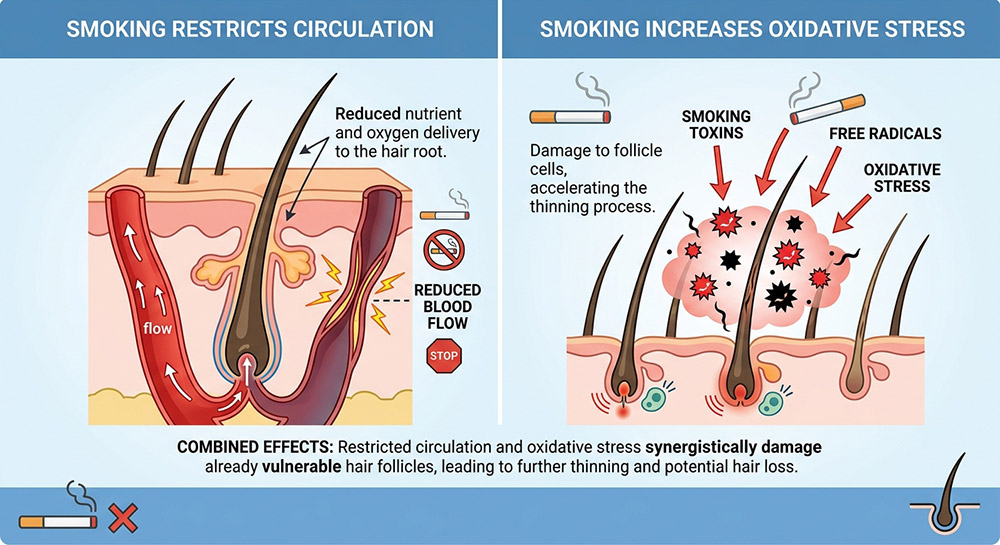
Smoking can restrict circulation and increase oxidative stress around hair follicles that are already vulnerable to thinning.
How Smoking Affects the Hair and Scalp
Healthy hair growth depends on functioning follicles, an adequate blood supply, and a scalp environment that supports each stage of the growth cycle. Smoking can interfere with these processes in several connected ways.
Reduced Blood Flow to the Follicles
Nicotine causes blood vessels to narrow, reducing the efficiency of circulation throughout the body. Hair follicles depend on the surrounding blood supply for oxygen and nutrients, so repeated restriction can make the scalp less supportive of strong, sustained hair growth.
Increased Oxidative Stress
Cigarette smoke produces unstable molecules known as free radicals. When these overwhelm the body’s natural defences, the resulting oxidative stress can damage cells, accelerate tissue ageing and disrupt the normal biological activity of the hair follicles.
Persistent Inflammation
The chemicals in tobacco smoke promote inflammation and interfere with normal tissue repair. When the scalp is already affected by irritation, poor health, or progressive follicle miniaturisation, this added inflammatory strain can further compromise the conditions needed for healthy growth.
Smoking and Male Pattern Hair Loss
Male pattern hair loss is primarily driven by genetics and sensitivity to dihydrotestosterone, or DHT. Susceptible follicles around the temples, frontal scalp and crown gradually become smaller, producing hairs that are finer, shorter and less visible with each growth cycle.
Smoking does not create this genetic sensitivity, but it can place further vascular and oxidative stress on follicles that are already miniaturising. By contrast, smoking alone is unlikely to explain sudden or widespread shedding. It can be connected to illness, severe stress, rapid weight loss, nutritional deficiency or another disruption to the hair growth cycle.
Vaping and Hair Loss: What the Evidence Shows
There is considerably less direct research into vaping and hair loss than there is into cigarette smoking. We therefore cannot conclude that vaping causes the same degree or pattern of hair loss as tobacco use.
However, many vaping products contain nicotine, which still constricts blood vessels and affects circulation. Nicotine strength and the other substances inhaled also vary between products, so vaping cannot be assumed to have no effect on the scalp simply because it does not produce conventional cigarette smoke.
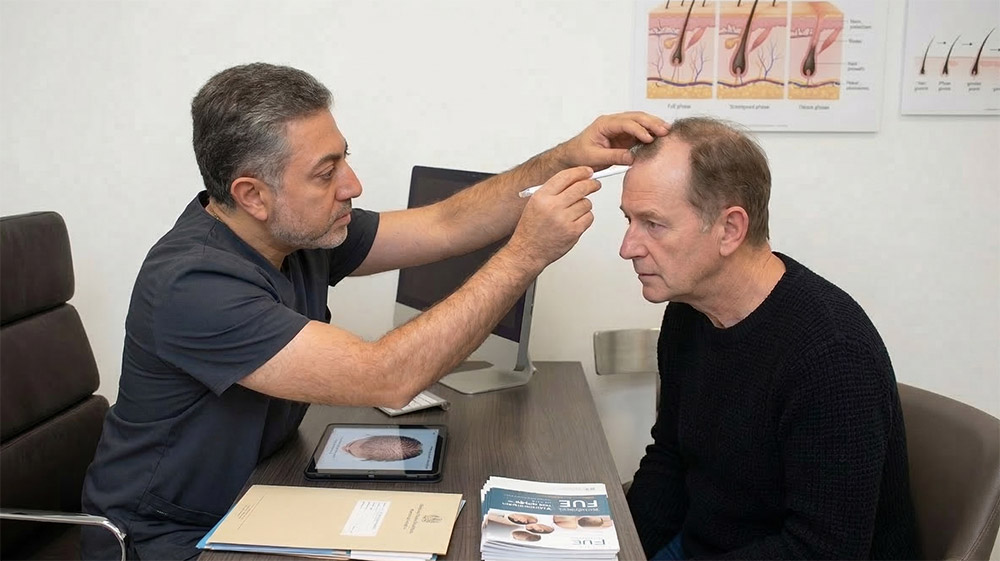
A clinical assessment helps distinguish smoking as a contributing factor from genetic, hormonal or medical causes of hair loss.
Hair Growth After Quitting Smoking
Stopping smoking improves circulation, oxygen delivery and the body’s ability to repair tissue. Removing this source of vascular and oxidative stress creates healthier conditions for the scalp, but any visible change in hair depends on the original cause of the loss and the condition of the follicles.
Quitting will not automatically reverse established male pattern baldness or restore follicles that have stopped producing hair. If the follicles remain active, better scalp health can support their function, but hair grows slowly, and any improvement in shedding or quality will take time to become apparent.
Smoking Before and After a Hair Transplant
Smoking is particularly relevant around a hair transplant because healing tissue and newly placed grafts depend on an effective blood supply. Nicotine narrows the blood vessels, while cigarette smoke reduces oxygen delivery and interferes with the body’s normal healing response.
At Fortes Clinic, we give every patient clear instructions about smoking and nicotine use before and after their procedure. These instructions also apply to vaping and nicotine replacement products where appropriate. Following them protects the healing donor and recipient areas and gives transplanted follicles the best possible conditions to establish themselves.
Smoking and Hair Loss: Why the Full Pattern Matters
Smoking can compromise circulation, increase oxidative stress and promote inflammation around the hair follicles. It is associated with androgenetic alopecia, but a receding hairline, thinning crown or period of increased shedding should never be attributed to smoking without considering the complete pattern and medical history.
At Fortes Clinic, we examine where density is being lost, whether the follicles are miniaturising and how the change has progressed over time. This allows us to determine whether smoking is one contributing factor within genetic hair loss or whether another hair or scalp condition needs to be considered before treatment is planned.
Book a Hair Loss Consultation in London
If your hair is thinning or you have noticed changes around the hairline or crown, a consultation at Fortes Clinic can help identify the likely cause. We will assess your scalp and hair, review how the loss has developed and explain which treatment options are appropriate. Contact us today to arrange a private consultation.
Contact Fortes Clinic
Email: hello@fortesclinic.co.uk
Phone: 020 7286 0000 or 07561 422719
Online Booking Form
Location: Fortes Clinic, 22 Clifton Road, Little Venice, London, W9 1ST
Smoking and Hair Loss FAQs
Can smoking cause permanent hair loss?
Smoking can contribute to conditions that compromise follicle health, but permanence depends on the underlying type of hair loss. In male pattern hair loss, affected follicles can eventually become so miniaturised that they no longer produce visible hair.
Does occasional smoking affect hair growth?
There is no established number of cigarettes below which smoking has no effect on the hair. Occasional smoking still exposes the body to nicotine and other chemicals, although duration, frequency, genetics and general health all influence the overall risk.
Does nicotine cause hair loss?
Nicotine constricts blood vessels and reduces the efficiency of circulation, including the blood supply supporting the scalp. It is not usually the sole cause of hair loss, but it can contribute to conditions that are less favourable for follicle function and tissue healing.
Can passive smoking affect the hair?
Passive smoke contains many of the same chemicals found in directly inhaled cigarette smoke. Its specific effect on hair loss is not as well established, although limiting exposure benefits overall health.
Does vaping cause hair loss?
Current evidence does not prove that vaping directly causes hair loss. However, nicotine-containing vaping products still affect the blood vessels, and the long-term impact of the different chemicals used in these products is not yet fully understood.
Will my hair grow back if I stop smoking?
Stopping smoking does not guarantee that lost hair will return. Regrowth depends on the cause of the hair loss and whether the affected follicles remain active enough to produce healthy hair.
How long does hair take to improve after quitting smoking?
There is no fixed timeline because hair grows in cycles and responds slowly to changes within the body. Any improvement in shedding, texture, or density usually takes several months to notice, not days or weeks.
Can smoking make male pattern baldness progress faster?
Research has found an association between smoking and the presence or progression of androgenetic alopecia. Genetics and hormonal sensitivity remain the main causes, but smoking can add further stress to follicles that are already susceptible to miniaturisation.
Why should smoking be avoided around a hair transplant?
Smoking restricts blood flow, reduces oxygen delivery and interferes with wound healing. Avoiding smoking and following the clinic’s nicotine guidance helps protect the donor area, recipient area and newly placed grafts during the critical healing period.
Should I mention vaping or nicotine use at my consultation?
Yes. We need to know about cigarettes, vaping, nicotine replacement products and other sources of nicotine when planning a hair transplant or assessing factors that could be affecting your hair and scalp.