Hair Loss Treatment for Men in London

- Personalised hair loss assessment
- Surgical & non-surgical treatment options
- Treatment tailored to your hair & health
- Subtle, natural-looking hair restoration
- Long-term hair loss planning & care
EXCELLENT Based on 117 reviews
 Posted on Google
 Oggy BoggyI’m incredibly happy with my hair transplant results after just five months. The difference has exceeded my expectations, and I couldn’t be happier with the outcome. Everyone at the clinic was friendly, professional, and made me feel comfortable from the initial consultation right through to the procedure and aftercare. They were always happy to answer any questions and made the whole experience stress-free. I would highly recommend this clinic to anyone considering a hair transplant. Thank you to the whole team!Posted on Google
 Davit GevorgyanHad a transplant done here at the surgery and it’s been a year since and I couldn’t be more happy with the results! Thank you to the team and to Dr SaaedPosted on Google
 Edward WilsonExcellent results from my hair transplant. I cannot recommend more highly. Thank you very much to Dr Saaed and the Fortes Clinic teamPosted on Google
 Nick BaldwinAmazing experience beginning to end - Dr. Ahmed did such an incredible job with my transplant and I wouldn’t be happier!Posted on Google
 H AminiHad my hair transplant done on Thursday — 1,700 grafts for the front corners and crown. The whole experience was genuinely excellent. I even fell asleep for part of it, which says a lot about how comfortable the process was. Dr Ahmad made me feel completely at ease, and the entire team were incredibly caring and attentive throughout the day. Lunch was provided, and having Netflix and music available made the whole experience feel relaxed and stress‑free. Looking forward to sharing an update on my results in around six months. Thanks again, everyone 💙Posted on Google
 Christian OldroydIncredible natural results and a world class experience!! I had an FUE hair transplant - I cannot recommend Fortis Clinic in London highly enough. I did a lot of research beforehand and even visited Harley Street, but Fortes just had a much better feel. There was no pressure and it didn't feel "salesy" at all; it was clear from the start they just really know what they are doing. One of the best things about them is that they only take one patient per day, so you are the sole focus of the entire team. The communication is excellent; they are so quick to respond to every email and call, which really put me at ease. On the day of the surgery, I was initially quite nervous about the pain, but it was actually very minimal and nothing like I had feared. Dr. Saed is a total expert—so professional and confident that you just know you’re in safe hands. They really look after you throughout the day (the lunch provided was a great touch!) and the aftercare package is spot on. They provide everything from the shampoo to a neck pillow, so you don’t have to worry about a thing once you leave. I’m now two weeks post-op and the results are already better than I ever imagined. The hairline looks incredibly natural, the scabs came off easily, and I had hardly any swelling or lingering pain. They are simply the best. Thank you again to the whole team for everything!Posted on Google
 Ismael SanchoI had a hair transplant here in January 2025 and it was amazing. I had about 2800 grafts or so (which is quite little) and it made a monumental difference to my hair. Dr Ahmad Saaed was great throughout , I was reassured by him at my initial consultation, where he was knowledgeable but also didn’t pressure me into any decisions. During the procedure Dr Ahmad and his team were also great, I had a largely painless and pleasant experience watching Netflix ! I almost fell asleep at points ! Afterwards, the team at Fortes were again great , and I am extremely happy with my results. I continue going there to receive PRP, which is a testament to how reliable they are ! I would recommend Fortes to anyone needing their relevant services.Posted on Google
 Colin DolanAbsolutely fantastic service. Dr Saeed was extremely professional and results of the treatment were excellent.Posted on Google
 haider shubbarI did a hair transplant at this clinic few days ago and just want to share my great experience. From the moment i walked in greeted by Gina's lovely smile to meeting Dr Ahmed for an honest and professional consultation who offered me different options with no pressure. I felt at ease throughout the procedure and a full post care package provided. Thank you once again, i look forward to the results!
At Fortes Clinic, hair loss treatment for women in London starts with an individual assessment rather than an assumption about the diagnosis. We consider the pattern, timing and possible influences on the hair growth cycle before discussing treatments intended to preserve existing hair, improve visible density or restore suitable areas.
Hair loss in women may appear as a widening part, reduced volume, increased shedding or localised recession rather than a clearly defined bald area. These changes can develop gradually or begin quite suddenly, and their cause is not always apparent from the way the hair looks.
What Does Hair Loss in Women Look Like?
Female hair loss can affect density, growth and manageability in several ways. Recognising the pattern helps guide further assessment, but appearance alone is not enough to confirm why it is happening.
You may notice:
- A parting that appears wider than before
- Greater scalp visibility beneath overhead lighting
- A thinner ponytail or a general loss of volume
- More hair coming away during washing or brushing
- Shorter, finer growth across the top of the scalp
- Recession around the temples or frontal hairline
Common Causes of Hair Loss in Women

Women can experience several forms of hair loss at the same time. A proper assessment considers not only where density has changed but also the timing, associated symptoms and any health or lifestyle factors that could have disrupted growth.
Female Pattern Hair Loss
Female pattern hair loss is a progressive condition in which susceptible follicles gradually produce finer hairs. It commonly reduces density across the top and central scalp while the frontal hairline remains relatively preserved, although the exact presentation varies. The British Association of Dermatologists patient information leaflet on female pattern hair loss covers how the condition is diagnosed and which treatments are currently available.
Telogen Effluvium and Postpartum Shedding
Telogen effluvium causes more hairs to enter the resting phase and may follow illness, emotional stress, surgery, rapid weight change, nutritional deficiency or childbirth. The shedding is generally diffuse and may become noticeable several weeks or months after the original trigger.
Alopecia and Scalp Conditions
Autoimmune, inflammatory and scarring forms of alopecia can cause patchy loss, tenderness, scaling or changes around individual follicles. Early assessment is particularly important when the scalp feels uncomfortable or the loss has developed quickly, as management depends on the precise condition.
Traction and Hair Breakage
Traction alopecia results from repeated tension on the hair, caused by tightly secured hairstyles, extensions or styling practices, which can weaken hair and affect follicles around the hairline. Breakage can also reduce apparent volume without the hair being lost from the root, so the distinction needs to be made during examination.
How Female Pattern Hair Loss Progresses
The Ludwig scale is one way of describing the severity of female pattern hair loss across the top of the scalp. It supports consistent clinical assessment, although women do not all progress through every stage or lose density at the same rate.
Stage 1:
Early thinning becomes visible around the central parting.
Stage 2:
The part widens and reduced density becomes clearer across a broader area.
Stage 3:
Thinning is extensive, with considerably more scalp visible across the top.
Stage 1:
Early thinning becomes visible around the central parting.
Stage 2:
The part widens and reduced density becomes clearer across a broader area.
Stage 3:
Thinning is extensive, with considerably more scalp visible across the top.
When Is Shedding More Than Normal?
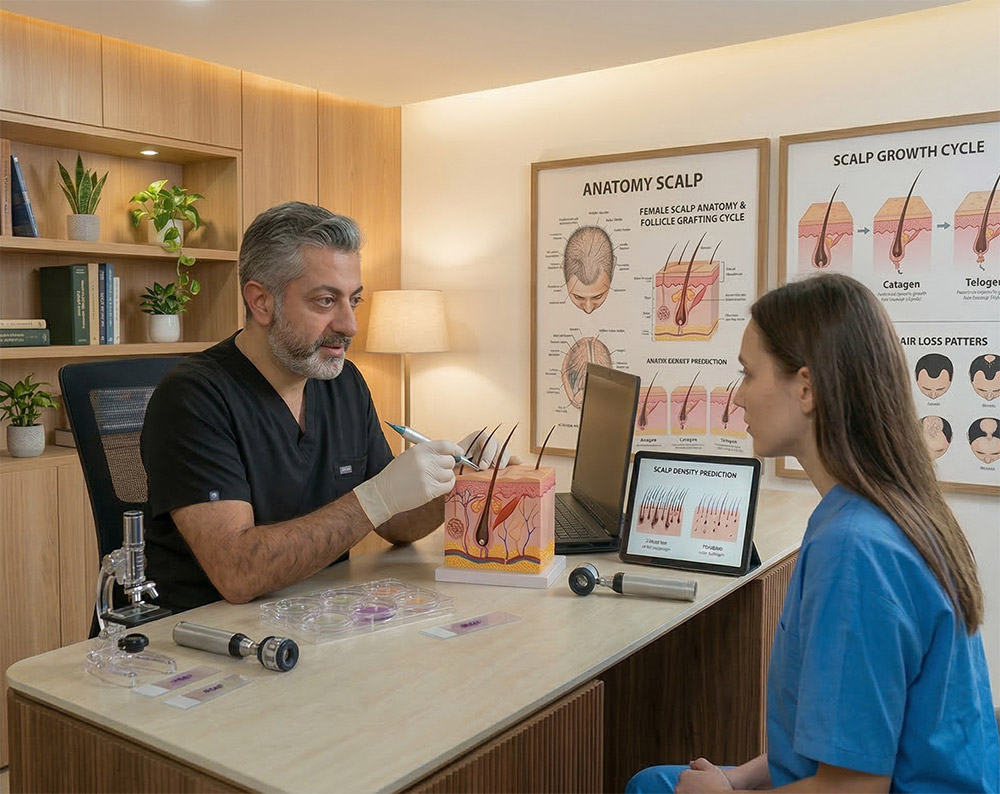
Everyone loses hair as part of the normal growth cycle, and the amount can vary between washing days and styling routines. A sustained increase, a clear reduction in density or shedding accompanied by scalp symptoms is more significant than a temporary rise noticed on one occasion.
It is worth arranging an assessment if the change continues, develops suddenly or affects distinct patches. Earlier evaluation can help identify whether the growth cycle has been disrupted, whether the follicles are becoming finer or whether another condition requires attention. Guidance from the NHS on hair loss covers when to see a GP and which causes may warrant investigation before any cosmetic treatment is considered.
How We Assess Female Hair Loss
We begin by discussing when the change started, how the hair has behaved since and whether anything occurred beforehand that could have affected growth. Medical history, medication, nutrition, hormonal changes, styling practices and family history may all provide useful context.
The scalp and hair are then examined for distribution, miniaturisation, breakage and signs of inflammation. Where appropriate, blood tests may be arranged to check iron or ferritin levels, thyroid function and, where clinically relevant, markers associated with PCOS, so that recommendations address the likely cause rather than the visible thinning alone.
Hair Loss Treatment Options for Women
Treatment is selected according to the diagnosis, the condition of the follicles and the type of improvement being sought. Fortes Clinic offers non-surgical and surgical approaches, with each option serving a different purpose within female hair restoration.

Hair Loss Medication
Appropriate hair loss medication may be considered to support growth or manage progressive thinning. Recommendations must take account of medical history, pregnancy considerations, possible side effects and whether ongoing use will be required to maintain any benefit.
PRP Hair Treatment

PRP treatment uses platelet-rich plasma prepared from a small sample of your own blood and introduced into selected areas of the scalp. It may form part of a plan for suitable women experiencing early thinning or reduced hair quality.

Scalp Micropigmentation
Scalp micropigmentation can reduce the contrast between the hair and scalp by adding carefully matched follicle-like pigment beneath areas of reduced density. It changes the visual appearance of thinning rather than causing hair to grow and can be used without surgery.
Female Hair Transplant

A female hair transplant moves healthy follicles from a stable donor area to selected areas of permanent loss. FUE, FUT or a combined approach may be considered, but suitability depends on having a reliable donor supply and a pattern that allows transplanted hair to produce a balanced improvement.
| Treatment | What it does | Who it typically suits | Creates new growth | Result is permanent |
|---|---|---|---|---|
| Hair Loss Medication | Supports growth and manages progressive thinning | Women wanting to slow progression, subject to medical suitability | Depends on individual response | No — depends on continued use |
| PRP Hair Treatment | Supports hair quality using the patient’s own plasma | Early thinning or reduced hair quality | Not typically framed as creating growth on its own | No — typically needs maintenance sessions |
| Scalp Micropigmentation | Reduces contrast beneath thinning hair | Women wanting cosmetic improvement without surgery | No | Long-lasting cosmetic result, not biological hair |
| Female Hair Transplant | Relocates follicles from donor to areas of permanent loss | Permanent thinning with a suitable, reliable donor supply | Yes | Yes, for transplanted follicles |
Which Female Hair Loss Treatment Is Right for Me?
The most suitable approach depends on why the hair is changing and whether the concern involves active shedding, progressive miniaturisation, permanent loss or visible scalp contrast. It also depends on your health, stage of life, previous treatment and the outcome you hope to achieve.
Some conditions should be investigated or stabilised before a cosmetic treatment is considered. Once the pattern is understood, we can explain whether one option is appropriate, whether treatments could play complementary roles or whether monitoring is the most sensible next step.

Why Choose Fortes Clinic for Your Female Hair Loss Treatment?
Female hair loss can develop in several ways, from increased shedding and a widening part to gradual loss of density across the scalp. At Fortes Clinic, we consider the pattern of change, potential triggers and the importance of preserving existing hair before recommending treatment. This allows us to create a plan based on the cause and progression of the hair loss, as well as the outcome you want to achieve.
Reasons women choose Fortes Clinic for hair loss treatment include:
Assessment shaped around female hair loss:
We consider when the changes began, how they are progressing and which health, hormonal or lifestyle factors may be involved.
Attention to existing hair:
Treatment planning considers how to preserve and support the hair that remains, particularly where thinning is diffuse.
More than one treatment pathway:
Medication, PRP, scalp micropigmentation and hair transplant surgery can be considered according to the diagnosis and intended outcome.
Subtle restoration planning:
Any cosmetic or surgical treatment is designed to work naturally with the surrounding hair, direction and density.
Continued clinical support:
Follow-up and aftercare are adapted to the chosen treatment rather than ending after the initial appointment.
Take the first step towards regaining your confidence and living life to the fullest today.
Meet Dr. Ahmad Saaed

FOUNDER / LEAD PRACTITIONER
Dr Saaed graduated from Medical school with a degree in Medicine and Surgery (MBChB) in 1997, later specialising as an Anaesthetist. He then trained professionally as a hair surgeon and trichologist and has been a member of the International Society of Hair Restoration Surgery since 2017. Dr Saaed has qualified in PRP Treatment with Dr Danial Sister, a renowned specialist in PRP and an author of the book “Platelet Rich Plasma, The New Frontier in Regenerative and Aesthetic Medicine”.
Book a Consultation for Female Hair Loss Treatment in London
If changes in density, shedding or your hairline are causing concern, a consultation for female hair loss treatment in London can help establish what may be happening and which options deserve consideration. Our assessment is personal, discreet and focused on recommendations that suit your hair, health and expectations. Contact Fortes Clinic to take the next step.
Contact Fortes Clinic
Email: hello@fortesclinic.co.uk
Phone: 020 7286 0000 or 07561 422719
Online Booking Form
Location: Fortes Clinic, 22 Clifton Road, Little Venice, London, W9 1ST
Frequently Asked Questions
What does female pattern hair loss look like?
Female pattern hair loss commonly causes a widening part and reduced density across the top of the scalp. The frontal hairline may remain intact, although some women also notice recession around the temples or a more general loss of volume.
Does female pattern hair loss grow back?
The thinning associated with female pattern hair loss is unlikely to improve on its own. Treatment may help slow further hair loss and improve density where the follicles are still producing hair, although results vary and continued treatment may be needed.
Can female pattern hair loss be reversed?
Although there is no permanent cure for female pattern hair loss, the condition can often be managed. Starting treatment earlier may help preserve existing hair, slow its progression and improve density.
Is female pattern hair loss permanent?
Without treatment, the follicle miniaturisation associated with female pattern hair loss tends to continue over time. Other causes of shedding, including telogen effluvium, may be temporary once the trigger has resolved, which is why the diagnosis matters.
Is female pattern hair loss genetic?
Genetics can contribute to female pattern hair loss, although a clear family history is not always present. Hormonal and age-related influences may also affect how and when the condition becomes visible.
What is the best treatment for thinning hair in women?
There is no universal best treatment because thinning hair has multiple possible causes. A suitable plan may involve medical management, PRP, cosmetic camouflage or surgery, depending on the diagnosis and the condition of the follicles.
At what age does women’s hair start thinning?
Hair thinning can occur at any adult age, but female pattern loss becomes more prevalent with age and may become more noticeable around or after menopause. Sudden shedding in a younger woman should still be assessed rather than dismissed as normal.
When should I seek help for female hair loss?
Arrange an assessment if shedding persists, density is clearly reducing or you develop patches, scalp discomfort or inflammation. A sudden or rapid change also deserves attention because it may have a different cause from gradual pattern thinning.
Can women with diffuse thinning have a hair transplant?
Some women with diffuse thinning are suitable for transplantation, but only when the donor area remains sufficiently strong and stable. If thinning also affects the potential donor region, moving those follicles may not provide a dependable long-term result.
Request a Consultation with Dr Saaed
Begin with a private, clinician-led consultation to discuss suitability, options, and expected outcomes.