Fortes Clinic | Last updated October 2026
FUE and FUT can both restore hair by moving healthy follicles from the donor area to areas affected by thinning or baldness. The main difference between FUE vs FUT is how those follicles are harvested, not the way they are positioned within the recipient area.
Neither technique is automatically better. Donor density, scalp laxity, graft requirements, hairstyle, scarring preferences and the likely progression of hair loss all influence which approach is more appropriate. At Fortes Clinic, we select the technique based on the complete restoration plan rather than recommending one method for every patient.
FUE and FUT Use Different Donor Harvesting Methods
Both techniques begin with an assessment of the donor area and end with individual follicular units being implanted at carefully planned angles and directions. The difference lies in how those grafts are obtained.
FUE Hair Transplant
Follicular Unit Extraction removes individual follicular units through small circular openings distributed across the donor area. The technique avoids a linear incision but leaves multiple small, dot-like scars where the grafts were extracted.
FUT Hair Transplant
Follicular Unit Transplantation removes a narrow strip of hair-bearing scalp from the donor area before the edges are closed. The strip is then dissected under magnification to produce individual follicular units, leaving a linear scar at the back or sides of the scalp.
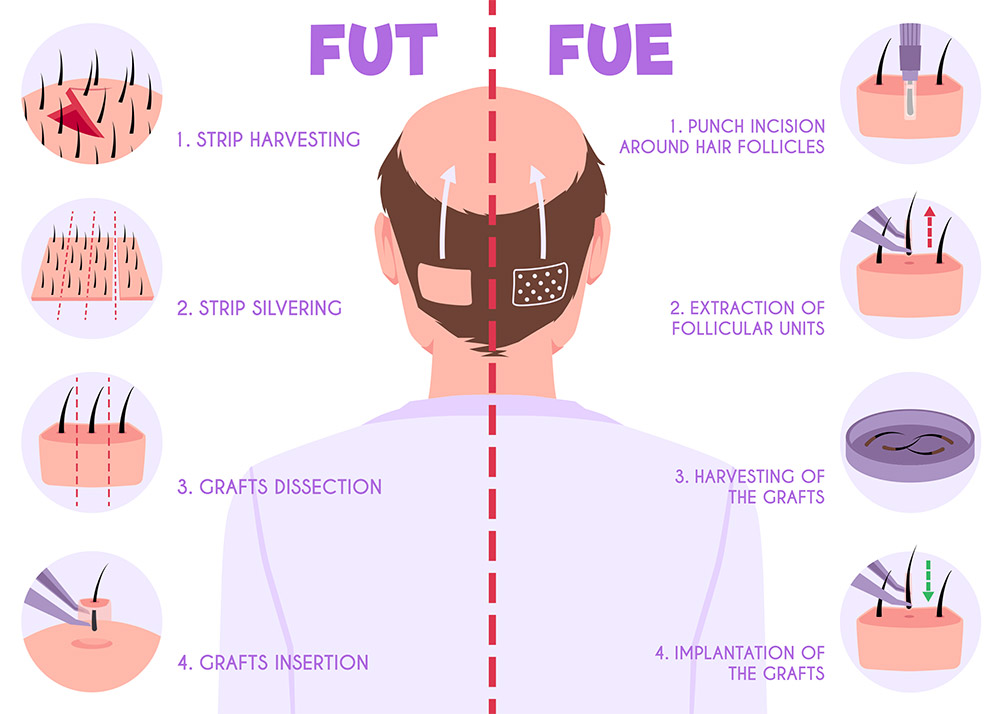
FUE extracts follicular units individually, while FUT removes a narrow strip of hair-bearing donor tissue.
FUE vs FUT: Key Differences at a Glance
The most important differences concern the donor area, scarring and recovery rather than the transplanted hair itself.
| Comparison | FUE | FUT |
|---|---|---|
| Harvesting method | Follicular units are extracted individually | A strip of hair-bearing scalp is removed and divided into grafts |
| Donor area | Extraction is distributed across a wider region | Grafts are collected from one concentrated strip |
| Scar pattern | Multiple small dot-like scars | One linear scar |
| Shaving | The donor area is usually shaved to some degree | Less extensive shaving may be possible |
| Early recovery | Small extraction sites heal across the donor area | The closed incision can initially feel tight or tender |
| Hairstyle | Can accommodate shorter hairstyles, although close shaving may reveal extraction marks | Enough length is generally required to conceal the linear scar |
| Graft planning | Substantial graft numbers are possible when donor density allows safe extraction | Higher graft numbers can be harvested efficiently in suitable patients |
| Results | Can produce natural-looking, long-term hair growth | Can produce natural-looking, long-term hair growth |
| Future treatment | Depends on the density and distribution left after extraction | Depends on remaining scalp laxity, donor supply and the existing scar |
Scarring After FUE and FUT
FUE is sometimes described as scarless, but this is incorrect. Each follicular unit is removed through a small opening that heals with a dot-like scar. These marks are usually difficult to see beneath the surrounding hair, although they can become more apparent if the scalp is shaved extremely closely or the donor area has been overharvested.
FUT creates a linear scar where the donor strip is removed, and the scalp is closed. A carefully positioned scar is generally concealed by the hair above and below it, but the individual will need to maintain enough length for coverage. Personal healing characteristics can affect the final width and appearance of either scar pattern.
Recovery After FUE and FUT
FUE usually has a shorter initial donor-area recovery because there is no linear incision or sutured closure. The extraction sites can feel tender and develop small scabs, but the surface generally heals as these sites close, and the shaved hair begins to regrow.
FUT recovery involves healing along the closed incision and can produce more tightness or discomfort at the back of the scalp during the early stages. Both procedures still require careful washing, temporary exercise restrictions, and protection of the donor and recipient areas while the skin heals.
FUE vs FUT Cost Depends on More Than the Technique
FUE can take longer because each follicular unit is identified and extracted separately. FUT allows a substantial number of grafts to be obtained from one donor strip, but it also involves surgical removal, closure and microscopic dissection of the tissue.
The final cost of a hair transplant therefore depends on the number of grafts required, the complexity and duration of the procedure, the clinical team involved and whether restoration is completed in one session or planned across several stages. At Fortes Clinic, we confirm the cost after assessing the hair-loss pattern and calculating a suitable graft number.
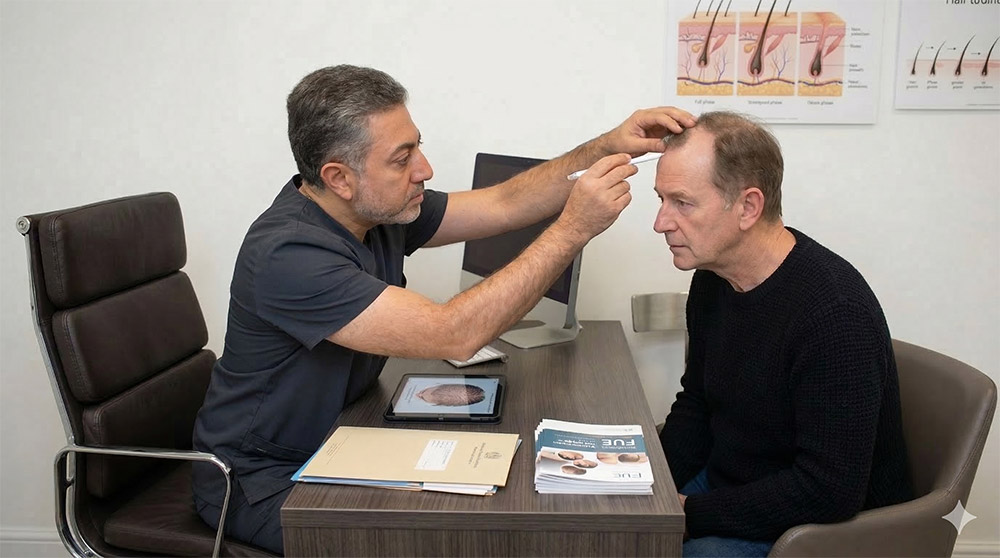
Donor density, scalp laxity and the number of grafts required must be assessed before selecting FUE or FUT.
FUE and FUT Can Produce Comparable Hair Growth
FUE and FUT do not produce fundamentally different types of transplanted hair. Once the grafts are prepared, the same principles apply to designing the hairline, creating the recipient sites, and placing each follicular unit at an appropriate angle, direction, and density.
The quality of the result depends on donor selection, graft handling, surgical planning and placement rather than the name of the harvesting technique alone. Both methods can produce natural-looking, long-term growth when the follicles are suitable and the procedure is planned and performed correctly.
How We Choose Between FUE and FUT
Choosing between FUE and FUT requires balancing the desired coverage against the limitations of the donor area and the likely progression of hair loss. At Fortes Clinic, we select the technique that uses the available donor hair responsibly and supports the patient’s immediate and long-term restoration plan.
The main factors we consider include:
- Donor hair density and distribution
- Scalp laxity
- Number of grafts required
- Size and location of the recipient area
- Hair calibre and characteristics
- Preferred hairstyle and scarring concerns
- Previous hair transplant procedures
- Likely future hair loss
- The need to preserve grafts for later treatment
When Combined FUE and FUT May Be Considered
For extensive hair loss, relying on one harvesting technique may not provide enough grafts to achieve the planned coverage while protecting the donor area. A combined approach uses FUT to obtain grafts from a donor strip and FUE to harvest additional follicular units individually.
Combined FUE and FUT is considered when graft demand is high; both techniques are clinically suitable, and coordinating the two methods provides a stronger use of the available donor supply. It is not necessary for every patient and should form part of a carefully planned long-term restoration strategy.
FUE vs FUT: The Donor Area Should Guide the Final Decision
FUE provides individual extraction without a linear scar, while FUT can collect a substantial number of grafts efficiently from a concentrated strip. These differences matter, but neither technique should be selected without considering the condition and limitations of the donor area.
At Fortes Clinic, we assess donor density, scalp laxity, hair calibre, existing scars, required coverage and the expected progression of hair loss before recommending FUE, FUT or a combined approach. The aim is to achieve natural-looking restoration while preserving balanced donor coverage and keeping future treatment options open.
Book a Hair Transplant Consultation in London
If you are comparing FUE and FUT, a consultation at Fortes Clinic can help determine which technique best suits your hair loss and donor characteristics. We will assess the available graft supply, discuss scarring and recovery and explain what each approach could realistically achieve. Contact us today to arrange a private consultation.
Contact Fortes Clinic
Email: hello@fortesclinic.co.uk
Phone: 020 7286 0000 or 07561 422719
Online Booking Form
Location: Fortes Clinic, 22 Clifton Road, Little Venice, London, W9 1ST
FUE and FUT Hair Transplant FAQs
What is the main difference between FUE and FUT?
The main difference is how follicles are removed from the donor area. FUE extracts individual follicular units, while FUT removes a strip of hair-bearing scalp that is divided into separate grafts.
Is FUE better than FUT?
FUE is not automatically better than FUT, and FUT is not automatically better than FUE. The right technique depends on donor density, scalp laxity, graft requirements, hairstyle, scarring preferences and long-term hair-loss planning.
Is FUE more expensive than FUT?
FUE can cost more in some cases because individual extraction is time-intensive, but this is not a universal rule. The final quotation depends on graft number, complexity, surgical time, and the overall treatment plan.
Is recovery faster after FUE or FUT?
Initial donor-area recovery is generally faster after FUE because there is no linear incision or sutured closure. FUT recovery can involve more tightness or discomfort while the incision heals.
Which technique leaves less visible scarring?
FUE avoids a linear scar but leaves multiple small dot-like scars across the donor area. FUT leaves one linear scar, which can usually be concealed when the surrounding hair is kept at a suitable length.
Does FUT always leave a permanent scar?
Yes, FUT leaves a linear scar where the donor strip is removed, and the scalp is closed. Its eventual width and visibility depend on surgical planning, closure, individual healing and hairstyle.
Do FUE and FUT produce different hair transplant results?
Both techniques can produce natural-looking, long-term growth because they implant harvested follicles using the same principles. The result depends more on graft quality, hairline design, placement and donor planning than on the extraction method alone.
Can FUT provide more grafts than FUE?
FUT can allow a high number of grafts to be harvested efficiently in a suitable patient. The number available still depends on donor density, scalp laxity and the dimensions of the strip that can be removed responsibly.
Can FUE and FUT be combined?
Yes, the two techniques can be combined when extensive restoration requires greater access to the available donor supply. Suitability depends on donor density, scalp laxity, previous procedures and the overall graft requirement.
How do you decide whether FUE or FUT is suitable?
We assess the hair-loss pattern, donor area, required coverage, preferred hairstyle, scalp laxity and likely future loss. We then recommend the technique that can achieve the restoration goals while protecting the donor area over the long term.